Last reviewed 6 September 2026
Export limits sound scary until you unpack what TasNetworks actually means by a soft cap — and what happens when a site gets a lower or zero-export outcome. For most Tasmanian homes adding rooftop solar or a battery, the rules are clearer than the rumour mill suggests.
This is a practical walk-through of basic micro embedded generation (micro-EG) export limits, how batteries sit inside those limits, and why a pre-application design check saves grief later. For the value side of the equation — whether you use, store or export surplus — see our companion guide on Tasmanian solar value. We’re not re-running feed-in tariff maths here.
The headline numbers for basic micro-EG
Under TasNetworks’ Basic Micro EG Connection Technical Requirements, export limits for basic micro-EG connections are set as follows (including energy storage systems where noted):
- Single-phase: soft export limit of 10 kW at the connection point (including ESS)
- Two-phase: soft export limit of 10 kW at the connection point (including ESS)
- Three-phase: soft export of 10 kW per phase (including ESS), with balanced output and a tight unbalance tolerance between phases
Those figures are the standard soft caps for basic micro-EG. They’re not a promise that every street can absorb that much forever — they’re the starting framework for inverter settings and applications.
TasNetworks publishes the detail in its embedded generation section, including the Basic Micro EG Connection Technical Requirements PDF, and has a separate page on residential solar connections. If you’re comparing quotes, ask the installer which document version they designed against and how the inverter export settings will be locked in.
Document versions matter. Requirements get updated; a quote written against last year’s PDF can invent headroom that isn’t there on today’s application. We design to the current published framework and say so on the proposal.
What “soft” export actually means
A soft export limit is not a hard trip that dumps your whole system offline the moment you nudge past the cap. Consistent with AS/NZS 4777.2, a soft limit means the inverter reduces output so ongoing export doesn’t stay above the approved limit.
In day-to-day terms: on a bright Sunday when nobody’s home, your array might be capable of more, but the inverter holds export to the approved soft cap. Generation you can use on-site still covers house loads first. That’s one reason self-consumption and storage matter more as streets fill up with solar.
People sometimes confuse soft limiting with “the solar turned off.” Usually it hasn’t. The inverter is throttling export while still serving the house. If you add a big midday load — dishwasher, heat pump hot water, EV charger in solar-aware mode — you often see export drop because the house ate the surplus. That’s useful behaviour, not a fault.
When limits go lower — or to zero export
Not every connection gets the full basic soft cap. TasNetworks can set a lower export limit after a technical study, and in limited circumstances a static zero-export limit may apply where network conditions require it.
Common drivers include existing asset ratings, local power quality, and how much consumer energy resource (solar and storage) is already on that part of the network. Rural feeders, long single-wire earth return (SWER) sections, and tightly constrained urban LV pockets can all look different on paper.
A Launceston cul-de-sac full of existing arrays can behave differently from a new build on the urban fringe. A long rural spur south of Hobart can look fine for a modest hybrid and still be fussy about export at noon. None of that is personal — it’s network physics and asset ratings.
Zero export doesn’t mean solar is pointless. It means surplus can’t be sold back — so the design should lean harder into daytime loads, hot water timing, and batteries. That’s exactly where a hybrid system and a clear use/store plan earn their keep.
Where batteries fit in the export picture
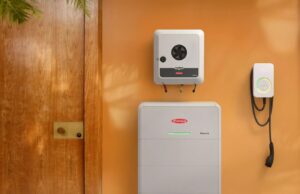
Battery systems (ESS) are included in the export limit at the connection point under the basic micro-EG rules. Charging from solar and discharging to the house is usually what people want; exporting from the battery is a separate conversation and often constrained by the same soft cap and retailer/VPP settings.
A well-designed hybrid can:
- Soak up midday surplus that would otherwise hit the soft cap
- Cover evening peaks when you’re importing from the grid
- Make a constrained or zero-export site still useful
It won’t magic away a network constraint. If TasNetworks assigns a low export allowance, we size and configure around that — not around a brochure that assumes unlimited export.
Explore options on our solar batteries in Tasmania and solar panels service pages, or talk through constrained sites on a design check.
One more nuance: adding a battery to an existing solar site can change how you use energy without changing the approved export number. The soft cap is still at the connection point. What changes is how much surplus ever tries to leave the property.
Design before you apply — not after
The expensive mistake is locking panel and inverter sizes on a quote, then discovering the approved export limit is lower than assumed. A pre-application design check flips that order:
- Look at phase count, existing generation, and switchboard capacity
- Propose a system that can still deliver household value under a soft cap or a tighter outcome
- Submit the TasNetworks application with settings that match the design
- Commission to the approved limit — and document it
If you’re on three-phase and chasing larger capacity, balance and per-phase limits matter. If you’re single-phase and already near the soft cap with an existing array, adding more panels without storage or load shifting may buy less than you think.
We see this often when someone wants to “just add another string” on a single-phase home that already exports hard at midday. The better question is whether daytime loads and storage can raise self-consumption before you grow nameplate kilowatts.
How this pairs with use, store or export
Export limits are a network rule. Value is a household rule. Once you know whether you’re on a standard soft cap, a reduced limit, or zero export, the next question is how you use daytime generation — running heat pump hot water, charging an EV, or storing in a battery. Our use, store or export guide covers that trade-off without turning this article into a FiT spreadsheet.
What to ask us on a pre-application design check
- What soft export assumption are you designing to for my phase setup?
- How would the proposal change if TasNetworks assigned a lower or zero-export outcome?
- Are existing arrays on the NMI counted correctly in the application story?
- Will inverter export settings be commissioned and documented to the approval?
- If I add a battery later, how does ESS sit inside the same connection-point limit?
Author: Scott Logie · Brand: Expert Energy Tasmania · Last reviewed: 6 September 2026
Want a pre-application design check? Contact Expert Energy Tasmania and we’ll review your phase setup, existing solar, and a realistic export scenario before you commit to hardware — then design batteries and panels around what TasNetworks is likely to approve.